
CONTACT OX
TO LEARN MORE
Give us a call at 800-345-8881 or fill out the form below
and we’ll get back to you within two business days.
The construction industry is under constant pressure to build faster, control costs, improve quality, and meet growing demand. At the same time, labor shortages and increasingly complex projects are prompting builders to rethink traditional construction methods and look for new ways to improve efficiency.
One approach gaining traction is modular construction, which can shift the bulk of the building process into a controlled manufacturing environment. By moving portions of construction off-site, modular building enables manufacturing and construction teams to streamline production, improve consistency, and reduce the amount of work required at the jobsite.
Understanding Modular Construction
Rather than assembling a structure piece by piece on-site, a modular approach involves individual modules built in advance, with major components such as walls, floors, ceilings, and mechanical systems installed before they even reach the job site. Once delivered, the modules are positioned, connected, and integrated to form what becomes the completed building.
Moving construction into a factory can create greater consistency and efficiency throughout the building process. Manufacturers can establish repeatable workflows that allow them to coordinate material and labor more efficiently than on a traditional job site subject to the impacts of external factors.
That efficiency can translate into measurable project benefits. According to an FMI Corporation study, prefabrication can help contractors save both time and money, with 78% of contractors reporting schedule savings and 66% reporting cost savings when implementing a modular construction approach.
But moving construction into a factory doesn’t eliminate every complexity of the construction process. It comes with its own checklist of considerations, from how materials perform during factory assembly to how they withstand transportation and installation at the jobsite.
Why Modular Construction Demands More from Sheathing
Sheathing plays a critical role in the performance of wall assemblies, providing structural support while helping address key building envelope requirements such as moisture management, air control, and thermal performance when equipped with the proper control layers. In conventional construction, these functions are often addressed through multiple materials installed at different stages of the project. In modular construction, however, much of the wall assembly is completed before it reaches the job site. As a result, sheathing becomes part of an assembly that must perform throughout the entire process, from initial installation in the factory to transportation, handling, and final placement.
Choosing the correct sheathing is critical not only for the performance of the finished building, but also for protecting the module throughout the construction process. Modular units tend to face stresses that traditional wall assemblies may not.
During transportation and crane lifting, modules can experience movement, wind loads, and shifting forces that put the wall assembly to the test. Sheathing without sufficient structural strength can allow frames to shift, twist, or bow. Weak fastener hold can also cause nails or staples to pull through, compromising the integrity of the assembly.
Moisture is another key consideration in modular construction. Modules may be exposed to rain and humidity while being stored, transported or awaiting final assembly. Materials that readily absorb water can swell, deteriorate, or create conditions for mold growth before the building envelope is fully enclosed. At the same time, an improper vapor-control strategy can limit a wall assembly’s ability to dry, trapping moisture within the wall and potentially leading to hidden damage where modular units join.
This makes the selection of a high-performance sheathing material particularly important for modular manufacturers. The right sheathing needs to provide the structural performance and building envelope protection required of the finished wall while also supporting the demands of the factory-construction and transportation process.
Simplifying the Building Envelope
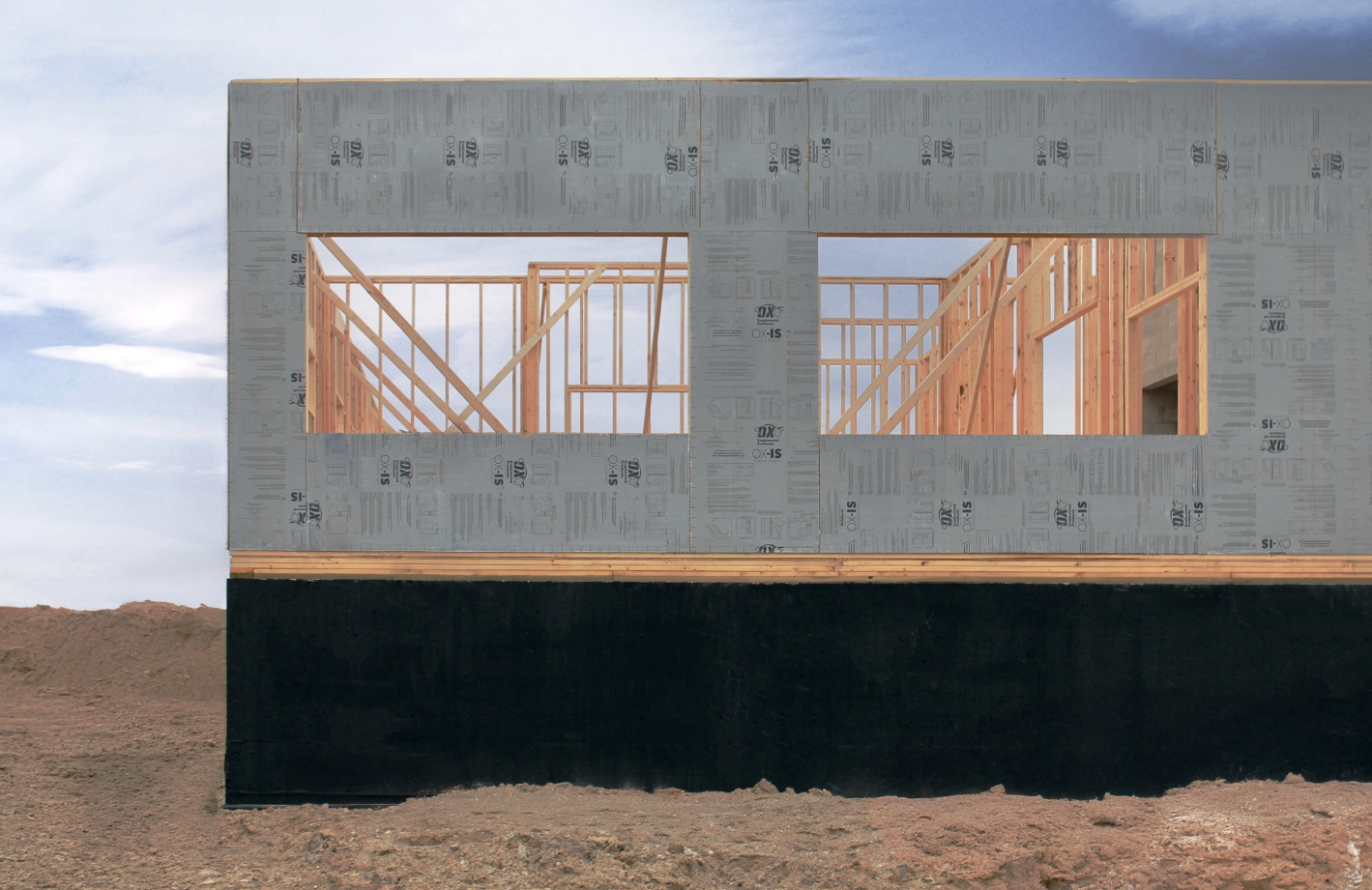
OX-IS structural insulated sheathing combines structural sheathing, continuous insulation, an air barrier and a water-resistive barrier in a single component. By integrating four building-envelope functions into one product, OX-IS can reduce the number of separate materials that need to be handled and installed, helping modular manufacturers create more efficient, repeatable wall assemblies.
That consolidation can be especially valuable in a factory setting, where production efficiency is critical, and manufacturers can benefit from a reduced number of steps required to complete the wall assembly before a module ships.
Those benefits extend to the jobsite. By completing more of the building envelope assembly before transportation, modular builders can help minimize the amount of work that remains once modules arrive on-site. Continuous insulation outside the framing also helps address thermal bridging and support the thermal performance of the wall assembly. Available in multiple thicknesses and R-values, OX-IS provides a single sheathing solution that can help modular builders balance installation efficiency with wall performance from factory to jobsite.
Designed for the Demands of Modular Construction
The advantages of modular construction extend beyond the factory floor. As wall assemblies move through production, transportation, and installation, the materials within them must be able to support both the efficiency of the manufacturing process and the performance expectations of the finished building.
That makes sheathing an important consideration for modular manufacturers. A solution that combines multiple building envelope functions into one can help simplify assembly, reduce material handling, and create greater consistency across production. OX-IS brings four necessary wall components into one weatherization system, helping streamline the path from wall assembly to finished enclosure.
Ultimately, successful modular construction is about more than building off-site. It’s about creating assemblies that are engineered to move efficiently through every stage of the process, and arrive at the jobsite ready to perform.